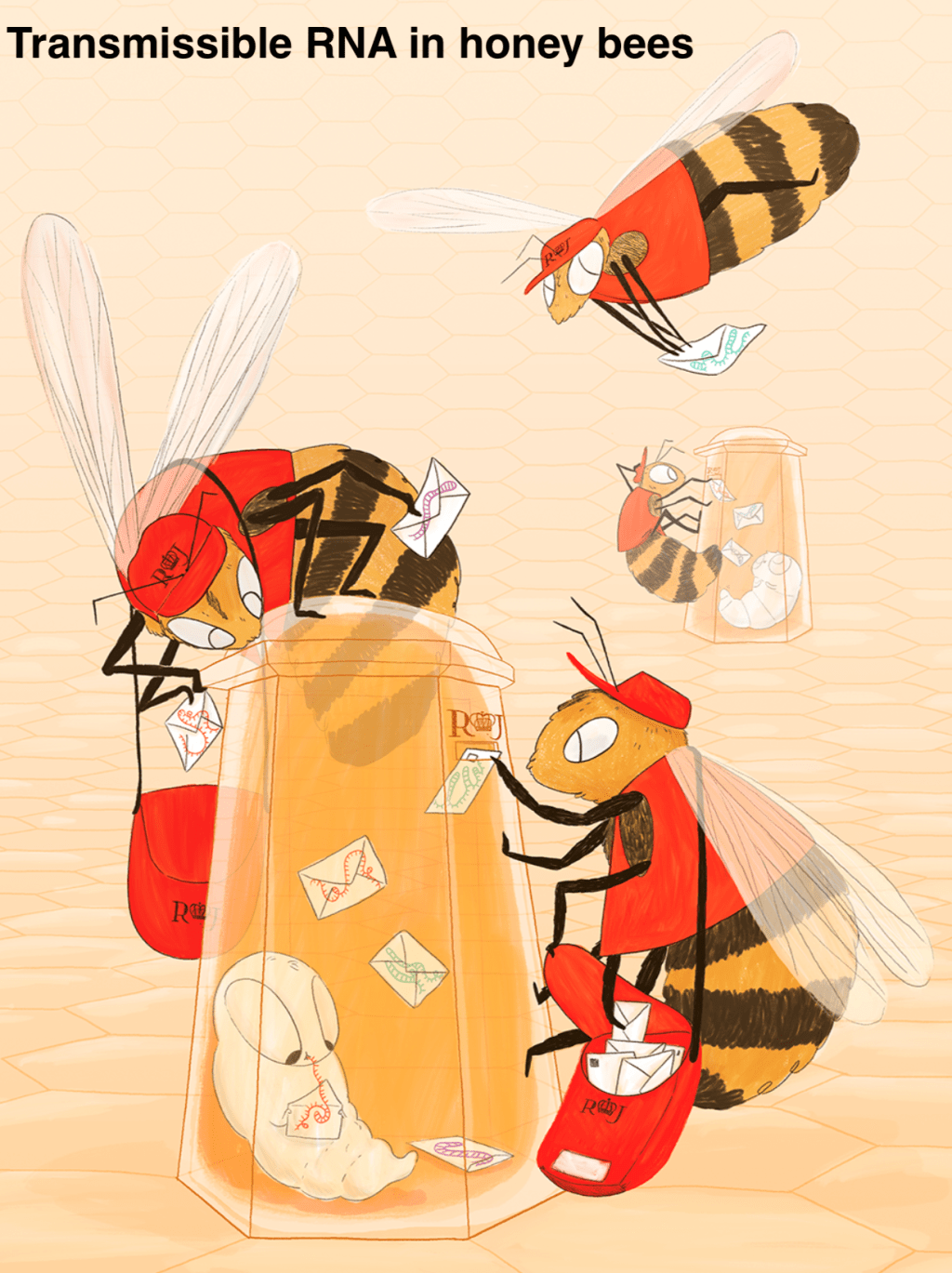
The secret RNA language of the bees
The Maori research group is based in the Department of Biochemistry at the University of Cambridge. We are interested in how organisms communicate with each other, and the honeybee is our main model.
Like all living organisms, honey bees store their genetic information in DNA. Although all cells in the body contain the same DNA, they have different shapes and functions, forming diverse tissues and organs. How does this happen?
A key reason is that the genetic information in DNA is expressed differently in each type of cell. This process involves converting specific sections of DNA, called genes, into RNA, another form of genetic information. RNA can then guide the production of proteins—molecular machines that perform many functions inside cells. RNA also plays a crucial role in regulating the activity of genes and their products.
RNA movement between cells within an organism has been observed in both animals and plants. Yet, it was once thought that RNA remained contained within the organism. Over the past decade, research has shown that RNA can spread beyond the organism it originated from and be transferred between individuals. Most examples of such transmissible RNA occur in host-parasite conflicts, where the transmitted RNA harms the recipient organism. So, why would any organism allow the uptake of foreign RNA?
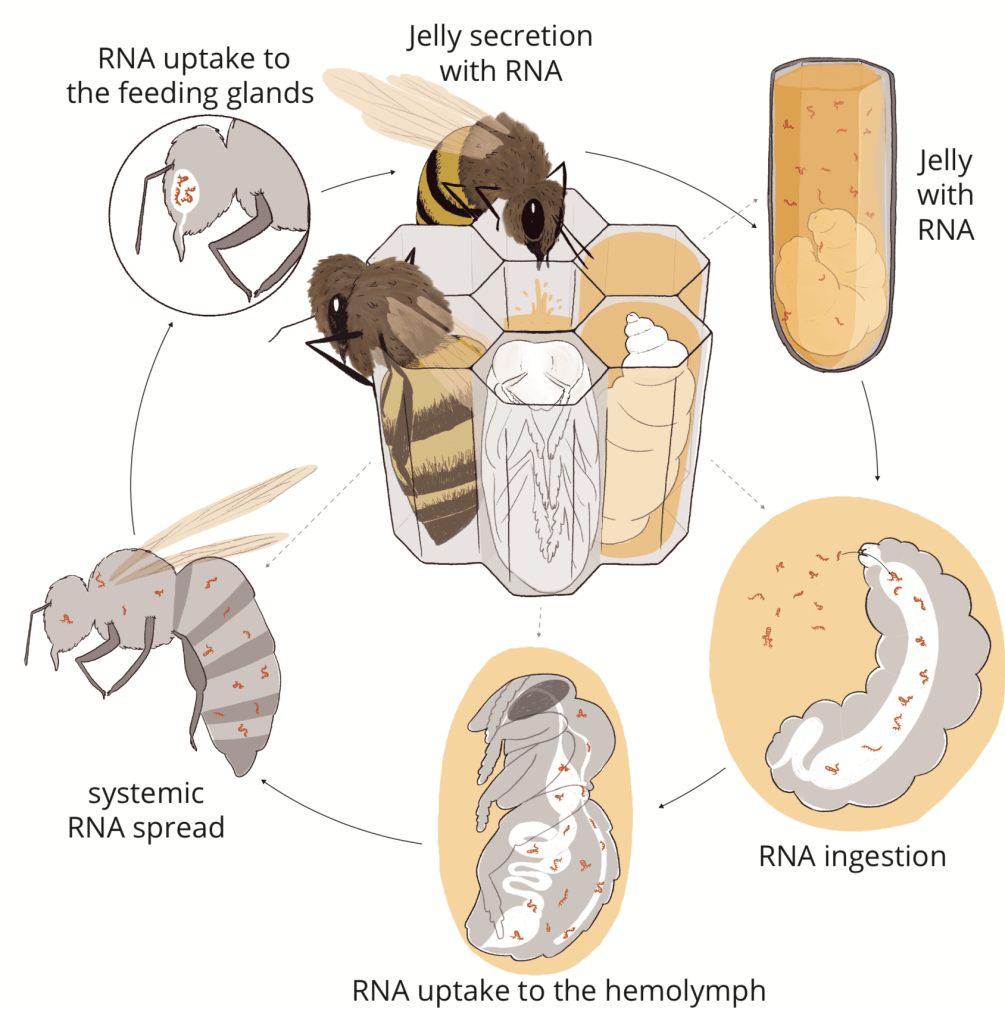
Recently, we unveiled RNA transmission between organisms, which could benefit the recipient individual. We found that honey bees share RNA (including anti-viral RNA) between individuals and across generations in the hive. RNA transmission among honey bees is mediated by ingestion of worker and royal jellies, provided by nurse bees to nourish the young developing larvae. We showed that transmitted RNA is biologically active and can turn off genes in recipient bees. We next asked how does the jelly support RNA transmission between honey bees? We discovered that bees secrete into
the jelly an RNA-binding protein called Major Royal Jelly Protein 3 (MRJP3), which concentrates, protects and enhances the activity of RNA.
Honey bees feed the larvae (the honey
bee ”babies”) with worker or royal jelly.
Within the jelly, the honey bees secrete
RNA molecules that the larvae ingest.
These RNAs are then distributed
throughout their bodies, regulating bee
genes and, potentially, protecting them
from pathogens such as viruses.
Why do honey bees exchange RNA with each other?
The discovery of this transmissible RNA pathway has sparked a lot of questions as to why and how honey bees exchange RNAs. Many of these RNA molecules originate from infectious viruses, bacteria, fungi, and plants. Therefore, we hypothesise that these RNAs are transmitted between individuals and across generations to protect from diseases that the hive encountered in the past. In a way, this RNA pathway could be viewed as analogous to our vaccination initiatives. However, this is just one of the
reasons why honey bees are exchanging RNAs. We are investigating other implications of this ‘secret language’ as well as the molecular mechanisms at play. These can inform us about the nature of honey bees and the origin of communication, providing insights into other organisms, such as humans.

 HIVE HEROES